Drainage-Focused Site Visit
We test percolation at multiple points, identify your dog's actual "zones," and walk you through infill options based on your household and soil type.
We design every pet turf around Orlando's heat, humidity, and rainy season with proper drainage, odor-resistant infill — so your yard doesn't smell, doesn't puddle, and stays looking great year after year.
Here's what changes day to day for Orlando dog owners that replace natural grass with artificial turf:
Orlando's downpours can quickly turn a natural yard into a mud pit. A properly drained pet turf stays dry within minutes of a storm, so you're not wiping down paws every time your dog comes in from the rain.
Concentrated urine kills natural grass, leaving behind dead patches no amount of reseeding fully fixes. Artificial turf doesn't die, discolor, or thin out from repeated use.
A reinforced, properly anchored turf system holds up to digging far better than a lawn, so a determined dog hits a compacted base instead of tearing up soil and leaving craters across the yard.
Multiple dogs sharing a yard means multiplied wear in the same zones. Artificial turf holds up evenly under that combined traffic instead of thinning out in the spots your dogs use most.
Many homeowners come to us after a lawn's already failed under daily dog use. That's why we build every pet turf installation around how your dogs actually use the yard, not a generic landscaping spec with extra infill added on.
Search "artificial grass for pets" or "fake grass for dogs" and most of what comes up is a paragraph or two about odor control bolted onto a landscaping page. That's the gap this page is meant to close. If you're comparing pet-friendly artificial grass installers in Orlando, the real differences are almost never visible in a photo; they're in the base depth, the backing perforation density, and the infill chemistry.
An Orlando dog yard faces three unique challenges that a regular turf isn't built to handle: concentrated urine hitting the same spots daily, Central Florida's mix of sandy and clay-heavy soils that drain at wildly different rates, and a rainy season that adds heavy, sudden downpours on top of daily pet traffic. Stack those together and it's easy to see why a turf system designed for a standard lawn doesn't hold up in a Lake Nona or Winter Park backyard with two Labradors.
We've also found that dogs almost never use a yard evenly. Most gravitate to one or two "zones" — along a fence line, beside a gate, or right off the lanai door — and those zones take far more punishment than the rest of the yard combined. That's why we walk every property and map out how your dog(s) actually use the space before recommending a drainage and infill spec.
This page is a deep dive into how we build pet turf systems in Orlando that last over a decade — covering drainage, infill, cost, warranty, and the household-specific details that separate a yard that stays fresh from one that starts smelling by year two. Jump to any section below, or read straight through.
What makes pet turf perform better? These are some of the design and performance factors we account for when building pet turf for Orlando yards.
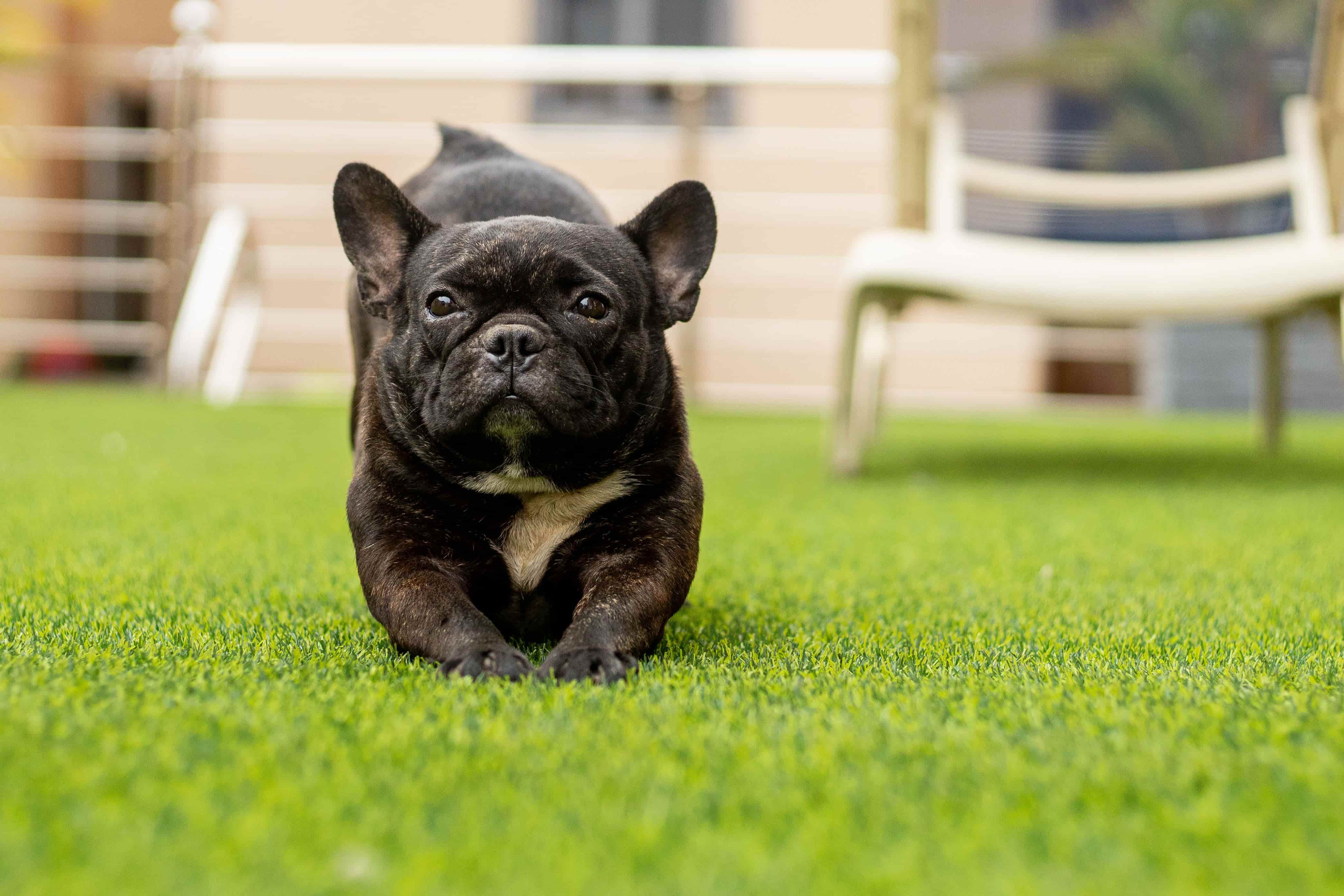
We test percolation at multiple points, identify your dog's actual "zones," and walk you through infill options based on your household and soil type.
A compacted, sloped aggregate base built deeper than a standard lawn install, sized to move urine through sand or denser clay-heavy soil alike.
Maximum-perforation backing, reinforced edge anchoring at fence lines and digging-prone zones, seams secured so they disappear — these are the details that keep your yard looking and smelling fresh years down the line.
Antimicrobial or zeolite infill worked into the fibers, an on-site water test to confirm drainage, then a full walkthrough of the finished yard with you.
Drainage is the single biggest factor in whether a dog yard smells bad or stays fresh for over a decade. Here's what's actually happening beneath the surface, and why Orlando's specific soil and rainfall patterns change the equation.
1. The base. We excavate deeper than a standard lawn install and compact a layered base of crushed granite or shell aggregate, graded with a slight slope to carry liquid away from the house, fence line, and any low spot a dog would stand in.
Why it matters to you: this is what prevents the "wet spot that never quite dries," which is the root cause of most turf odor complaints we get called out to diagnose.
2. The geotextile fabric. A permeable weed-and-separation fabric sits between the compacted base and the turf backing. It keeps aggregate from migrating up into the infill while still letting liquid pass straight through. This layer is one of the first things a budget installer skips or downgrades.
Why it matters to you: without it, you typically see lumpy, uneven turf and weeds pushing through within a year or two.
3. The perforated backing. Standard landscape turf backing has drainage holes spaced for rainwater. Our pet-grade backing uses a denser hole pattern — generally 30+ perforations per square foot vs. roughly half that on standard turf — so urine doesn't need to travel to find a drainage point, it can pass through easily.
Why it matters to you: this is usually the single biggest reason two "pet turf" quotes can look nearly identical on paper, yet one develops an odor problem after a season and the other doesn't.
Central Florida's soil isn't uniform, even within the same zip code. Newer developments like Lake Nona and Horizon West tend to sit on sandy, fast-draining soil. Older, established neighborhoods closer to downtown and Winter Park often have denser, clay-heavier soil that holds water longer. Lots near a lake or retention pond can also carry a higher water table. None of those extremes is good news for a dog: sandy soil that drains too fast can leave a base under-compacted, while clay-heavy soil that drains too slowly is exactly where odor problems start.
On top of that, Orlando's rainy season adds a second stress test. From roughly June through October, frequent afternoon downpours mean the same base handling daily pet traffic also has to move a heavy volume of stormwater without backing up. A pet-specific drainage plan has to account for both loads at once, not just one or the other.
That's why we test percolation at multiple points across the yard during the site visit and adjust aggregate depth and slope section by section — particularly under the zones your dogs actually use.
Infill does more than weigh the turf down — for a dog yard, it's the layer actually responsible for odor control. For most pet turf installs, we recommend zeolite infill for multi-dog households and antimicrobial silica sand for single- and two-dog homes. Both hold up to Central Florida humidity far better than organic infills, which break down faster in our climate. Here's how the options compare:
| Infill Type | Odor Control | Drainage Impact | Cooling | Best For |
|---|---|---|---|---|
| Antimicrobial silica sand Most Popular | Good: coated to inhibit the bacterial growth that causes ammonia smell | Minimal impact, drains freely | Standard | Most residential pet yards; our default for single/two-dog homes |
| Zeolite Best Odor Control | Best: mineral structure actively absorbs and traps ammonia molecules | Slight — benefits from periodic rinsing to keep absorption capacity fresh | Standard | Multi-dog households and yards with heavy, concentrated use |
| Walnut shell / organic blends | Fair: natural odor masking, breaks down faster in Florida heat and humidity | Good drainage | Standard | Light-use yards; needs more frequent replenishment here than in drier climates |
| Cooling infill (ceramic-coated) Best For Heat | Good when paired with an antimicrobial coating | Good | Reduces surface temperature noticeably | Barefoot-heavy pool decks and lanais, small breeds, senior dogs sensitive to heat |
| No infill / infill-free systems | Depends entirely on backing and rinsing routine | Excellent | Runs hotter with nothing to buffer heat | Rarely our recommendation for Central Florida dog turf |
Recycled rubber infill is common on sports turf because it's cushioned and inexpensive, but it retains heat aggressively under Orlando's direct sun, and it holds onto odor in a way that's harder to rinse clean than sand-based infills. For a dog yard specifically, we steer clients toward sand-based or zeolite infill unless there's a specific reason, like a padded play surface.
The "best" infill often comes down to the household more than the breed. A single Labrador that roams the whole yard evenly may do perfectly well with antimicrobial silica, while two small dogs that repeatedly return to the same corner near the lanai can benefit from upgrading to zeolite despite producing less total waste overall.
"Pet friendly" gets used loosely across this industry. Here's what should actually change between a standard residential lawn and a true pet-friendly artificial grass installation.
| Spec | Standard Lawn Turf | Pet-Friendly Turf |
|---|---|---|
| Backing perforation | Rain-oriented, fewer drainage points | Dense perforation pattern for point-source liquid |
| Pile height | 1.5"–2" for a natural lawn look | Often slightly shorter (1.25"–1.75") so waste doesn't get trapped deep in the fibers |
| Infill | Standard silica sand for weight and blade support | Antimicrobial or zeolite blend for odor control |
| Base depth | Typically 3–4 inches of compacted aggregate | Often deeper (4–6+ inches) with tighter slope tolerances near waste zones |
| Backing material | Standard polyurethane coating | Often a secondary drainage layer bonded beneath the primary backing |
| Edge securing | Standard staking/nailing | Reinforced edge anchoring in digging-prone zones and along fence lines |
If a quote for "pet turf" looks identical in price and materials to a standard lawn quote, ask specifically what's different about the backing, base depth, and infill. If the honest answer is "just the infill," the drainage engineering underneath hasn't changed, which can create odor issues down the line.
We'll walk your yard, test drainage on the spot, and recommend the right base and infill for your dogs and your soil — free, no obligation.
A single senior beagle in Winter Park and three off-leash Labradors in Horizon West put very different demands on a yard. We adjust the spec accordingly.
Larger, high-energy breeds put real stress on seams and edges, and diggers will test any weak point in the perimeter. We use reinforced edge anchoring and tighter seam spacing in these yards, and build the base deep enough that a determined digger hits compacted aggregate within the first couple inches instead of soft fill.
Small dogs are more likely to find and exploit a gap at a fence line or turf edge than to damage the turf itself. We pay extra attention to perimeter sealing and, where it makes sense, coordinate with any fencing work so there's no gap a small dog can squeeze under along the turf edge.
Multiple dogs mean concentrated, repeat traffic in the same corners — usually along fence lines and near the lanai or back door. Those zones get zeolite infill and extra base depth as standard practice, since a generic single-dog spec typically falls short within a year or two.
For older dogs with arthritis or joint sensitivity, we can add a cushioned shock-pad layer beneath the turf for extra give underfoot, along with a cooling infill option so the surface stays comfortable for a dog that spends more time lying directly on it.
We use pet-appropriate, lead-free materials and reinforce exposed edges, but artificial turf is not intended to be chewed or ingested. Puppies and persistent chewers should be supervised while adjusting to the new surface.
For your pet-boarding and daycare facility, you typically need turf built for continuous, heavy multi-dog rotation — this calls for denser face weight, maximum-perforation backing, and a maintenance plan built around daily rinse-downs rather than the lighter routine a single-family yard needs. We quote these separately since traffic volume changes the spec.
A lot of Orlando properties, especially in older neighborhoods near downtown, have a narrow side yard between the house and the property line that turns into bare dirt or mud once it becomes the default dog bathroom spot. Rather than turfing the whole property, a dedicated dog run in that exact space is often the more practical and more affordable fix.
These runs get the heaviest-duty spec we install: maximum perforation backing, the deepest base we use for any residential application, and zeolite infill as standard.
We also frequently pair a dog run with a small paver or gravel transition strip at the gate — the highest-wear entry point — to reduce turf stress right at the access point.
Urine odor isn't really the smell of urine itself — it's actually the smell of bacteria breaking down the urea in urine into ammonia. Fresh urine has relatively little odor, but the smell builds as bacteria colonize any spot where liquid and organic residue sit undisturbed, which is exactly what happens on a surface with poor drainage or infill.
Orlando's humidity accelerates that bacterial growth compared to drier climates. When homeowners call us about an existing turf odor problem, the synthetic grass itself is rarely the issue. More often, the odor traces back to installation details under the surface: an undersized base, poor grading, inadequate drainage, or an infill that wasn't matched to how the yard is actually used.
Surface heat. Any dark surface, natural or artificial, heats up in direct Florida sun. Lighter blade colors, cooling infill, and shaded areas all help, and we generally recommend the same precautions you'd use on hot pavement: avoid peak midday sun for barefoot play, and rinse the surface on the hottest days.
Ingestion risk during install. Infill particles and adhesive at seams are generally not a concern once cured, but we recommend keeping pets off freshly installed turf for the timeframe we specify at the walkthrough while adhesives fully set.
This isn't veterinary advice. If your dog has a specific skin sensitivity or medical condition, it's worth mentioning to your vet before switching surfaces. We can share the specific infill and backing materials we're planning to use so you can check with them directly.
Pet turf needs more attention than a standard lawn install, but still far less than real grass. Here's the routine that keeps an Orlando dog yard odor-free.
Remove solid waste the same day, just like on natural grass, so it doesn't sit in the heat.
A plain water hose-down of high-traffic zones flushes residue before bacteria have time to establish, more often during peak summer humidity.
A pet-turf enzymatic cleaner breaks down organic buildup a plain rinse won't fully clear.
Brushing lifts flattened fibers in high-traffic zones; we check whether infill needs topping up in year one.
Pet turf typically runs higher per square foot than a standard lawn install because of the deeper base, denser backing, and odor-control infill. Here are typical starting prices by project type:
| Project Type | Typical Starting Price | What drives the price |
|---|---|---|
| Single-dog backyard, standard turf + antimicrobial infill Most Requested | $8+ / sq ft | Base depth, yard size, existing drainage condition |
| Multi-dog household, zeolite infill | $10+ / sq ft | Infill upgrade, deeper base, reinforced edges |
| Dedicated dog run / side yard | $11+ / sq ft | Smaller total area raises per-sq-ft cost; premium spec throughout |
| Senior dog / cushioned shock-pad system | $12+ / sq ft | Added shock-pad layer plus cooling infill |
| Condo patio / lanai turf for pets | $9+ / sq ft | Pad system over hardscape, drainage tied into existing structural drains |
| Boarding, daycare, or kennel facility | Quoted per project | Commercial-grade backing, traffic volume, drainage capacity needed |
Larger projects typically land at a lower per-square-foot rate than a small isolated area, since mobilization and base setup costs are spread across more square footage.
Pet turf and its installation are warrantied like standard turf — but odor and infill performance are not, since both vary based on upkeep. We go over exactly what's covered, for how long, and our recommendations for protecting that coverage during your on-site estimate.
| Item | Typically Covered? | Why |
|---|---|---|
| Turf fiber (UV fading, fraying, defects) | ✓ Yes Manufacturer warranty, usually 8–15 years |
Same product warranty as standard lawn turf; the fiber material itself doesn't change for pet applications |
| Installation workmanship (seams, base settling, drainage) | ✓ Yes Installer warranty, reviewed with you in detail |
Covers errors in how the base and backing were installed, separate from the manufacturer's product warranty |
| Odor performance | ✗ Not Usually | Odor is driven by drainage quality and your rinse/cleaning routine; we walk you through upkeep recommendations |
| Infill effectiveness (zeolite, antimicrobial) | ~ Partial Shorter window than the fiber |
Infill breaks down and needs topping up under heavy dog use |
| Digging, chewing, or pet damage | ✗ No | Treated like normal wear-and-tear |
Most homeowners only compare price, but the biggest differences between pet turf installations are usually hidden underneath the finished surface. Before choosing an installer, these are the questions we'd recommend asking every company — including us.
A quality installer should explain exactly how liquid leaves the yard, not simply say the turf "drains well." Ask whether they evaluate existing drainage, adjust grading, and build different base depths for high-use dog areas, especially given how much Orlando's soil varies block to block.
Many companies simply install their standard landscape turf and market it as pet-friendly. Ask what specifically changes for a pet installation — backing, infill, pile height, drainage, edge construction, or all of the above.
A good installer should explain exactly how to keep the turf clean years from now, not just how great it'll look on installation day. Understanding rinsing, enzyme cleaners, and infill maintenance now helps avoid odor issues later.
Ask what's covered separately for the turf product, installation workmanship, seams, settling, drainage, and odor — those are very different issues, and they aren't always protected by the same warranty. See our full warranty breakdown above for exactly how we split this out.
"Our yard used to turn into a swamp every time it rained, thanks to three dogs doing their business. Now with the new turf, I can actually stand out there in August and not gag. Wish we'd done this years ago."
"What sold me was that they actually tested how different parts of our yard drained before giving us a number, nobody else bothered with that. Our older dog has arthritis, so they threw in a cushioned layer for her joints. Little things like that go a long way, thank you!"
"Honestly expected a sales pitch, but they just walked us through what each infill actually does and let us decide. We ended up with zeolite for our two labs, and it's made it through an entire rainy season without any funky smells."
Specific questions about pet turf for dogs in Orlando:
The best artificial grass or fake grass for dogs isn't really about the blade, it's the backing and infill underneath that determines whether it holds up. A shorter pile height (1.25"–1.75") so waste doesn't get trapped deep in the fibers, dense perforated backing, and antimicrobial or zeolite infill are what separate turf built for dogs vs. turf that quickly struggle with odor and durability. We can walk you through which turf spec fits your household during your free estimate.
Yes, when it's built with the right backing and infill. Fake grass for dogs to pee on needs denser perforations than a standard lawn turf so urine drains through instead of pooling, plus antimicrobial or zeolite infill to control odor. Turf without that pet-specific drainage layer can start smelling within a season, regardless of how good the blade looks on day one.
Zeolite generally performs best for odor control since its mineral structure actively traps ammonia rather than just letting liquid pass through, great option for multi-dog households. Antimicrobial-coated silica sand is a strong budget-friendly option for single or two-dog homes. Organic infills like walnut shell, however, offer some odor masking but break down faster in Orlando's heat and humidity than in drier climates.
Pet turf typically runs $2–$4 more per square foot than standard lawn turf, mainly due to the deeper excavation, denser perforated backing, and antimicrobial or zeolite infill. Most residential pet turf projects start around $8+ per square foot, with dedicated dog runs and multi-dog installations sitting at the higher end because of the reinforced edge work and premium infill involved. Call us for a free on-site estimate to get an exact number for your yard.
Yes, when the base and backing are built for it. We provide a deeper compacted aggregate base and use reinforced edge anchoring in yards with large or high-energy dogs, so the perimeter and seams hold up to digging and repeated hard play rather than lifting or shifting.
We recommend a plain water rinse two to three times a week in high-traffic zones, with a monthly pass using an enzymatic pet-turf cleaner for deeper odor control. Because Orlando's humidity accelerates bacterial growth compared to drier climates, households with more dogs or heavier use benefit from rinsing daily in the specific spots a dog returns to repeatedly, especially through the summer months.
Generally yes. Fleas, ticks, and hookworm larvae rely on soil and organic thatch, conditions a well-drained turf system doesn't provide the way bare dirt or a damp St. Augustine lawn does. Turf also removes the habitat that draws fire ants into thin or bare patches of natural grass.
Any turf can get hot in direct, all-day sun, sometimes more than the surrounding air temperature. But lighter blade colors and cooling infill both help meaningfully, and we recommend the same precautions you'd use on any surface exposed to full sun — try to avoid peak midday heat for barefoot play, and rinse the surface down on the hottest days.
The real differences are under the surface: a denser perforated backing built for urine rather than just rainfall, a deeper and more precisely sloped base, antimicrobial or zeolite infill instead of standard sand, and reinforced edge anchoring in digging-prone areas. If a quoted "pet turf" install only differs by infill type, you may encounter issues with odor control down the line.
Yes, and it's often the more practical option for a side yard or narrow strip that's already become the default bathroom spot. Dog runs get our heaviest-duty spec — maximum perforation backing, the deepest base we use residentially, and zeolite infill as standard.
Our quality turf fiber itself does not stain or discolor from urine. Visible discoloration issues on other installs usually trace back to mineral or infill residue building up on the surface rather than the turf material reacting to urine. Routine rinsing prevents that buildup from occurring.
A properly built pet turf system typically lasts 10+ years even under heavy multi-dog use. Infill may need topping up sooner, generally within the first several years depending on traffic volume. We offer industry-leading warranty, and can walk you through the details.
Yes, we can add a shock-absorbing pad layer beneath the turf for extra cushion, paired with a cooling infill option, which many clients choose for older dogs with arthritis or joint sensitivity, or dogs that spend extended time lying directly on the surface.
Yes, and small spaces are actually a common pet turf request we see, especially across Orlando's condo and townhome-heavy communities where a full backyard isn't an option. These projects still need proper drainage planning even at a small scale, since a poorly built base in a small enclosed space can be worse for odor.
Yes, balcony and lanai pet turf uses a perforated pad system over the existing hardscape, with drainage points planned around the structure's existing drains rather than a ground-level base, plus consideration for added weight specific to elevated installations.
Solid waste should be picked up the same way it would be on natural grass, ideally same day. Turf doesn't absorb or break down solid waste any differently than grass would, so regular pickup stays part of the routine regardless of surface type.
It depends on the size and scope of the project, similar to any turf installation — some municipalities require a permit once the area crosses a certain square footage or affects stormwater drainage calculations. We check what applies to your specific address before work begins.
Many HOA communities allow artificial turf, though requirements vary regarding product appearance, installation methods, and visible edges. Florida Statute 125.572 (effective 2025) limits how much cities and counties can restrict turf outright, but it doesn't override private HOA architectural review covenants. Some HOAs still evaluate a pet turf or dog run installation through their standard review process, and we can provide the samples and documentation most boards request for these submissions.
Yes, given how many travelers pass through Orlando, pet boarding and daycare facilities are common, and they need a heavier-duty spec than a residential yard — denser face weight, maximum-perforation backing, and a drainage system built for continuous multi-dog rotation rather than a single household's traffic. We quote these based on your facility's layout and expected volume.
Most dogs stop digging once the turf is properly secured because they quickly reach the compacted aggregate base underneath. Dogs determined to dig at fence lines may still need behavioral training, but reinforced perimeter anchoring significantly reduces the chance of damage.
Yes, turf is commonly installed around pools because it won't turn muddy, reduces grass clippings entering the water, and dries quickly after swimming or a rinse-off. Around pools we often recommend cooling infill and careful drainage planning to manage both rainwater and splash-out.
Properly installed pet turf is designed to drain heavy rainfall quickly, but our rainy season and hurricane season can leave behind branches, leaves, and other debris that should be removed. After heavy storms we recommend inspecting seams, edges, and drainage areas before allowing heavy pet use again.
Absolutely. Many Orlando homeowners install turf only in the portion of the yard their dogs use most frequently, such as a side-yard dog run or the area closest to the lanai. This often provides the biggest improvement while keeping overall project costs lower than replacing the entire lawn.
Yes, we use quality, lead-free materials, although we recommend pets stay off the surface until installation adhesives have fully cured. Puppies may still chew on grass fibers like they would natural grass, so supervision is recommended while they adjust to the new surface.
Yes. St. Johns River Water Management District's mandatory watering schedule applies whether or not you have pets, and a heavily used dog yard is often the hardest part of a lawn to keep green under those restrictions anyway, since foot traffic and urine spots compound the stress. Turf removes that struggle entirely and stays consistent regardless of watering days.
Both. Pet turf is a common requested project we handle across Orlando, and it uses a different spec than a standard lawn install — different backing perforation, base depth, and infill. For general landscaping turf, you can learn more here.
Vacation rental owners in the Kissimmee, Davenport, and Celebration corridor who list as pet-friendly deal with dogs from different guests, which usually means heavier, less predictable use. We typically recommend the multi-dog spec — deeper base, zeolite infill — for pet-friendly rental yards even if any single stay only involves one dog, since the cumulative turnover adds up similarly to a multi-dog household.
We install artificial grass for pets throughout Orlando and the surrounding Central Florida region, including many of the area's most established neighborhoods and growing communities.
See our full service area on the homepage for more detail, or just give us a call to confirm your address.
Call now for a free pet turf estimate, or send the form and we'll follow up.
Phone: (689) 600-5868
Service area: Orlando, Winter Park, Dr. Phillips, Lake Nona, Windermere, Kissimmee, Winter Garden, and the rest of Orange, Seminole, and Osceola Counties.